Sunday, December 9, 2018

Two Kinds of Music Students

“Creativity is a type of learning process where the teacher and pupil are located in the same individual.”–Arthur Koestler, author
The tricky passage that finally rings true, the ‘aha’ moment, the transcendent performance – all are creative achievements that result from learning.
In effect, the more adept we become at learning, the more facile we’re likely to be with the creative process.
And for us musicians, only deep learning enables us to perform securely and artistically under pressure.
From Musiciansway.com


I’ve observed that music students generally divide into two types of learners: deep or shallow.
Here are some distinctions between those two types.
“The more adept we become at learning, the more facile we’re likely to be with the creative process.”

Deep vs Shallow Learners

Deep Learners

•  Set specific practice goals and then work in organized yet flexible ways
•  Isolate problem spots in practice – they vocalize rhythms, play hands alone, recite song text, etc.
•  Maintain awareness as they play or sing, directing their actions from within
•  Infuse their practice with joy and spontaneity
•  Manage repetition so that they absorb passages without needing to repeat them ad nauseum
•  Listen intently in practice and evaluate their work with open minds
•  Embody excellence
•  Perform securely and enthusiastically

Shallow Learners

•  Practice haphazardly without clear objectives or are overly rigid and mechanical
•  Play or sing through lengthy sections without attending to specific details
•  Often let their attention wander during practice
•  View practice as drudgery that must be endured
•  Repeat endlessly, hoping that repetition alone will bring security
•  Evaluate sporadically, often drifting off pitch and out of rhythm
•  Let inaccuracies and difficulties slide by unaddressed
•  Deal with persistent performance anxiety and may dread performing


The Musician's Way book coverFortunately, musicians with shallow learning habits can transform themselves into deep learners by setting clear goals, gaining disciplined practice habits, employing self-motivation strategies, and seeking expert guidance.

Sunday, April 8, 2018

Double Tonguing

http://banddirectorstalkshop.com/2018/04/07/demystifying-the-double-tongue-technique/


DEMYSTIFYING THE DOUBLE TONGUE TECHNIQUE

Articulation is something that brass players must practice on a daily basis. There are many types of articulation, legato to staccato, that help determine style. Additionally, speed is another aspect that must be practiced. After a certain tempo, single tonguing (just using a “T” syllable) is not feasible due to the fast tempo. Brass players have a technique called double and triple tonguing to assist with articulating notes at fast tempos. Lastly, syncing (aligning) the fingers and tongue at different tempi is another technique that must be practiced.

Before practicing multiple tonguing, one must possess a good single tongue technique. Problems arise when too much manipulation occurs to place the tongue in certain areas of the mouth. It is best to take a simple approach. I like to tell students to say, “Tu”. Wherever the tongue hits, that is where one “tongues”.
According to the famous cornet teacher, Jean-Baptiste Arban, “Always remember that the phrase coup de langue (stroke of the tongue) is merely a conventional expression. The tongue does not strike; on the contrary, it performs a retrograde movement, simply behaving like a valve… the pronunciation of the syllable “tu” serves to determine the attack of the sound.”
Arban further states, “…He warns the pupil that the word “striking” is only a term and that the tongue does not give a blow as to strike but instead operates with a backward movement like the action of a valve.”
There is a misnomer that the tongue strikes harder for a shorter note. The tongue only releases the air, and how one releases the air determines the type of articulation. The air should never stop when articulating; rather, the air is interrupted. The tip of the tongue (in the front of the mouth) is what interrupts the air to articulate. This movement should be practiced on one note initially before adding notes on different pitches and with that, finger motion. It is ideal to practice scales and exercises based on scales to produce a solid single tongue articulation.
Once a solid single tongue technique has been established, it is then appropriate to move on to multiple tonguing. I feel that learning a good double tongue technique before the triple tongue is best. It should be noted that the famous “Arban” method introduces the triple tongue initially in the book before introducing the double tongue exercises.
A great exercise to practice is one in which the T and K syllables are isolated and practiced separately. Most students struggle with the K syllable initially. The K syllable is simply articulating with the back of the tongue. The back of the tongue rises and momentarily obstructs the air. Arban explains it best, “The tongue should then reascend to the roof of the mouth and obstruct the throat, dilating itself by the effect of the pronunciation of the syllable ku, which, by allowing a column of air to penetrate into the mouthpiece, determines the K [sic] sound”.
I recommend starting students on multiple tonguing as early as possible but only after a good sound and single tongue articulation has been achieved.
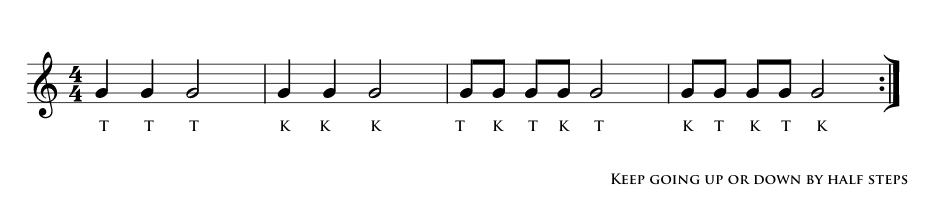
This is a great exercise to isolate the “K” syllable in the double tongue. The exercise should be practiced at quarter note = 100. The tempo can be increased as one’s tonguing ability improves. It is essential to keep a fast and intense air stream flowing through the instrument in order to produce an even alternation between the single and double tongue syllables 
so that the rhythm doesn’t have a swing feel. 
Use one pitch (middle register) for the entire exercise and go either up or down chromatically to get repetitions on the exercise.
Raquel Rodriquez is the Assistant Professor of Trumpet at Tennessee Tech University. Raquel maintains a versatile career as a performing artist, clinician, educator, and scholar. Raquel is principal trumpet of the Bryan Symphony Orchestra and the Brass Arts Quintet, both faculty ensembles-in-residence at Tennessee Tech. Raquel is principal cornet with the Southern Stars Symphonic Brass Band (TN) and a member of Seraph Brass. You may read more about Dr. Rodriquez at http://www.solotromba.com/home/

Tuesday, February 6, 2018

Band Isn't Fun Anymore by Scott Lang

This is the clarion call of late September. Gone are the fun-filled days of band camp where team building and bonding activities were paramount and smiles were aplenty. The energy of new faces, new music, and new drill have been replaced with the drudgery of cleaning the opener while simultaneously trying to get the ballad on the field and memorize the closer. 
The repetition and drudgery associated with daily rehearsals are starting to take there toll, but the energy and enthusiasm associated with contests and competitions are a ways away.
Add to this homework, tests, jobs, and the other responsibilities associated with being a teenager, and your students might be right, band might not be fun anymore. Here 's a secret... It’s not supposed to be fun. You never said it would be fun. You said it would be memorable.

Except for the occasional trip to an amusement park, there is very little in my teenage life that was “fun” that I can remember. 

I am sure that going to the movies was fun, but I don’t remember what I saw. I am positive that going on dates was fun, but I can’t remember a single one of them, and trust me, there weren 't that many to remember. I would guess that going out to lunch with my friends was fun, but I don't remember where we went or what we ate. I 'm positive that hanging out with my friends on a Friday night was fun, but for the life of me, I can’t remember ever doing it. I don’t remember doing anything fun, but I remember band. 

image
Perhaps you should take just a minute and write down some of your favorite memories from band experience. You could even do this with your section to be reminded that even though the activity can be difficult, it is important to remember how special these times are.
I remember being so hot that I thought I was going to die, but running back to my spot anyway. I remember being so exhausted for early morning rehearsals, but crawling out of bed anyway. I remember being so sick of marching and playing the same three songs each and every day, but playing and marching them again anyway. I remember them like they were yesterday. I remember the good. I remember the bad, and the people I shared it with. I remember band.
Yes, band isn’t fun anymore. But then again, you never said it would be. You know what band is? Band is worthwhile. Band is life-changing. Band is working hard with the same people, fighting through the bad days, and celebrating the good ones together. Band is memorable. Band is family. Band is sleepless nights and never-ending days. That’s what band is.
And I remember it like it was yesterday!
Have a great week everyone. Work to do soemthing FUN for your section.
Have a great week!
image


Thursday, November 2, 2017

TUNING TIPS FOR CLARINET by Paula Corley

http://www.dansr.com/vandoren/resources/tuning-tips-for-clarinet?utm_source=getresponse&utm_medium=email&utm_campaign=vandoren_wave_master&utm_content=Tuning+Tips+for+Clarinet+

Author’s Note: It is essential that clarinetists have good equipment in order to play as “in tune” as possible and blend with other wind and string instruments. This applies to everything: instrument, mouthpiece, and reeds. Mouthpieces can greatly affect pitch as can barrel length and design. Reeds may affect to a lesser degree (reeds too soft may equal ‘sagging’ pitch and loss of focus). Ligatures affect more of the tone ‘color’ rather than pitch.
Choose equipment that promotes solid intonation on the “Best Clarinet Tuning Notes” listed below. The 12th’s (chalumeau to clarion) should match between registers. For example, if the bottom note is sharp, so should the upper note.

Step One: 

Warm-up your instrument. Play long, slow notes for at least 3 minutes. Begin in the chalumeau (low) register and work your way up to the clarion (middle) register.


Step Two: 

Check the notes below with your tuner. Check all 4 notes before adjusting anything. Note whether you are sharp or flat on each pitch.

If you are flat, here are two possibilities: 
1) your instrument is still cold; 
2) there may a problem with your equipment – mouthpiece choice; barrel length. 
An unfocused clarinet tone will almost always be flat. To check for focus, play on your barrel and mouthpiece first. Your barrel and mouthpiece should match a focused F# (as close as possible.)

Step Three: 

Check Open G again. If you are sharp, pull the barrel out. On some instruments, pulling out to get the open G ‘in tune’ will make other notes flat. Venting (the use of extra fingers down) may need to be used on Open G (and subsequent tones G#, A, Bb) to bring the pitch down. (See tuning tendency chart.)
Concert A (your B-natural) should be pretty close to ‘in tune’ after tuning Open G. If it is still sharp, pull the bell out slightly.
The C-G 12th connection may be affected by pulling the middle joint. While some notes in the lower clarion may be affected by pulling the middle joint, others may not.

Barrel length and design affects tuning. 

Most clarinetists need a 66 millimeter barrel to play in tune. A 65 will raise the tuning and a 67 will lower the tuning but are also acceptable choices. There are many custom barrel designs available that can also change the tuning of the clarinet. Purchasing a new barrel can be expensive and should be a careful process done through extensive testing with a tuner.

Mouthpieces affect tuning. 

Look for mouthpieces that say American Pitch, A440, etc. Again, purchasing a mouthpiece can be complicated and requires testing with a tuner. In choosing a mouthpiece, one must also consider ‘ease of playing’ as well as tuning. If your pitch is extremely sharp, you can pull the mouthpiece out slightly. This is not recommended except in extreme cases.
Below, you will find a tuning tendency chart. It is essential to know your tuning tendencies so that you compromise with piano, other winds, and strings.
Each clarinet manufacturer builds instruments with relatively similar tuning tendencies. Most also build instruments with an ‘even scale’ meaning that the interval distance (between the notes) is accurate.
The acoustical design of the clarinet leaves very little room for pitch adjustment. Adjusting the pitch of any particular note while playing can be problematic because the embouchure must be involved. It is very easy to lose the focus of the sound if the embouchure becomes too loose. Biting the mouthpiece to try and raise the pitch may cause the sound to lose its’ ‘presence.’ Therefore, many professional players seek out master repair persons to ‘undercut’ the tone holes on the clarinet. Undercutting is a process where the shape of the tone hole is changed, which affects the pitch of individual notes. Key height can also be adjusted to assist in the tuning process.

“Bringing Down the House” (Pitch)

How do you bring down or bring up the pitch while playing passages in your music? The reality is clarinetists cannot significantly change the pitch of any given note. However, minute reductions in the amount of lip surface next to the reed and/or lip pressure may help lower the pitch slightly.
In “Advanced Intonation Technique for Clarinets/JB Linear Music” (September 19, 2006), John Gibson concludes:
“There are three basic ways to change the pitch while playing. One is to change the embouchure by firming around the mouthpiece to go higher or loosening to go lower. Remember, it is firming, not biting. Some control can be had by pushing upward or relaxing the pressure with the right hand thumb. A better route in some situations is to use alternate fingerings. An altissimo G can be fingered many ways and some may be more in tune on your instrument than the standard fingering. Also, adding fingers or opening tone holes by depressing a key can change intonation as well as resonance. Lastly, shading tone holes is a useful skill. While playing a low C, lower the right hand fingers close to the tone holes to lower the pitch…”

James Lockwood in “Pitch Adjustments in Clarinet Playing/The Journal of the Acoustical Society of America”, May 1978, Volume 63, Issue S1, page S57 states:
“Both damping and reed aperture changes may be effective in pitch adjustments made while playing…It is suggested that the single effect that dominates pitch control in a given case depends on the shape of the mouthpiece (facing)… (A closed facing)…that remains practically flat against the reed…lends itself to damping control through variation of the position and firmness of the lip. (An open facing where) there is already a significant gap at the lip position, lends itself to reed aperture control through variation of the lip pressure.”

What does all of this mean?

Basically it is easier to lower a given pitch (while playing) by moving the bottom lip first. Lockwood found that a “closed” mouthpiece responds to “damping” – (rolling more lip inside or outside the mouth). An “open” mouthpiece responds to relaxing lip pressure (without moving the lip in or out).
A “Closed” mouthpiece has very little space between the top of the reed and the mouthpiece surface. An “Open” mouthpiece has a large space between the top of the reed and the mouthpiece surface.
After warming up, check the pitch of each note with a tuner. Do this process several times over a few days for consistency. Mark each note appropriately: flat – 0 in tune – sharp.

Thursday, August 17, 2017

Clarinet embouchure check list

Transcription: Hi everyone, those lazy summer days are almost over! It’s time to put away your summer gear, get your clarinet out, and start getting back into shape. Today, I’m going to give you an embouchure checklist to help you get back into the groove.

You are going to need a few things to help you with your embouchure checklist.
First, you will need a mirror, large enough to see your entire face. This will allow you to watch yourself play to make sure you are keeping your embouchure correct while you practice.
Second, of course, you are going to need your clarinet. Okay, let’s get started.

 A good embouchure allows maximum vibration of the reed and allows you to control the sound over all dynamic levels from the lowest note to the highest.
 1. First, fold your bottom lip over your bottom teeth, push you jaw slightly forward, so your top and bottom teeth are parallel, and then stretch your chin muscles flat against your jaw, like so.
 2. Next, leverage your mouthpiece to your top teeth. Now you can create a seal around the mouthpiece. Bring your corners in and your top lip down. This will help you control the sound and prevent air leakage.
 3. Whenever you go to play, your sound should be warm, vibrant, and easy to control. Don’t forget to take a big breath when you go to play.

  Now I’m going to show you how you can practice this on your own at home.
 Go ahead and get that mirror out, and put it on your stand. This is how you are going to watch yourself play.
 Bottom lip over bottom teeth, jaw forward, chin flat.
 Leverage your mouthpiece to the top teeth, and create a seal, bringing your corners in and your top lip down.
 Double check in the mirror and make sure all parts of the embouchure look correct.

 While you’re playing, always check into the mirror to make sure you are keeping your chin flat. As soon as you see you may be doing something incorrectly, go back through the steps of making a good embouchure and then continue playing. Let’s review this one more time. Don’t forget to have your mirror. Fold your bottom lip over your bottom teeth, jaw slightly forward and flatten your chin. Bring your corners in and your top lip down and go ahead and play! Great job today! Contact me through my website, www.callyclarinet.com for further questions. Thank you so much for watching!

Saturday, August 12, 2017

What Students Really Need to Hear

What Students Really Need to Hear
Posted by CHASEMIELKE on MARCH 8, 2014 It’s 4 a.m.

https://affectiveliving.com

 I’ve struggled for the last hour to go to sleep. But, I can’t. Yet again, I am tossing and turning, unable to shut down my brain. Why? Because I am stressed about my students. Really stressed. I’m so stressed that I can only think to write down what I really want to say — the real truth I’ve been needing to say — and vow to myself that I will let my students hear what I really think tomorrow. 

 This is what students really need to hear: First, you need to know right now that I care about you. In fact, I care about you more than you may care about yourself. And I care not just about your grades or your test scores, but about you as a person. And, because I care, I need to be honest with you. Do I have permission to be honest with you — both in what I say and how I say it?

Here’s the thing: I lose sleep because of you. Every week.

 Before I tell you why, you should understand the truth about school. You see, the main event of school is not academic learning. It never has been. It never will be. And, if you find someone who is passionate in claiming that it is about academics, that person is lying to himself or herself and may genuinely believe that lie. Yes, algebra, essay writing, Spanish, the judicial process — all are important and worth knowing. But they are not the MAIN event.

 The main event is learning how to deal with the harshness of life when it gets difficult — how to overcome problems as simple as a forgotten locker combination, to obnoxious peers, to gossip, to people doubting you, to asking for help in the face of self-doubt, to pushing yourself to concentrate when a million other thoughts and temptations are fingertips away.

  It is your resilience in conquering the main event — adversity — that truly prepares you for life after school. Because, mark my words, school is not the most challenging time you will have in life. You will face far greater challenges than these. Sure, you will have times more amazing than you can imagine, but you will also confront incomparable tragedy, frustration, and fear in the years to come.

 But, you shouldn’t be worried about the fact that you will face great adversities. You should be worried because you’re setting yourself up to fail at overcoming them. Here’s the real reason I lose hours of sleep worrying about you: You are failing the main event of school. You are quitting. You may not think you are quitting, but you are because quitting wears many masks.

 For some, you quit by throwing the day away and not even trying to write a sentence or a fraction because you think it doesn’t matter or you can’t or there’s no point. But it does. What you write is not the main event. The fact that you do take charge of your own fear and doubt in order to write when you are challenged — THAT is the main event.

 Some of you quit by skipping class on your free education. Being punctual to fit the mold of the classroom is not the main event of showing up. The main event is delaying your temptation and investing in your own intelligence — understanding that sometimes short-term pain creates long-term gain and that great people make sacrifices for a greater good.

 For others, you quit by being rude and disrespectful to adults in the hallway who ask you to come to class. Bowing to authority is not the main event. The main event is learning how to problem solve maturely, not letting your judgement be tainted by the stains of emotion.

 I see some of you quit by choosing not to take opportunities to work harder and pass a class, no matter how far down you are. The main event is not getting a number to tell you you are worthy. The main event is pulling your crap together and making hard choices and sacrifices when things seem impossible. It is finding hope in the hopeless, courage in the chasm, guts in the grave.

 What you need to see is that every time you take the easy way out, you are building a habit of quitting. And it will destroy your future and it will annihilate your happiness if you let it. Our society cares nothing for quitters. Life will let you die alone, depressed, and poor if you can’t man or woman up enough to deal with hardship. You are either the muscle or the dirt. You either take resistance and grow stronger or blow in the wind and erode.

 As long as you are in my life, I am not going to let quitting be easy for you. I am going to challenge you, confront you, push you, and coach you. You can whine. You can throw a tantrum. You can shout and swear and stomp and cry. And the next day, guess what? I will be here waiting — smiling and patient — to give you a fresh start. Because you are worth it.

 So, do yourself a favor: Step up. No more excuses. No more justifications. No blaming. No quitting. Just pick your head up. Rip the cords out of your ears. Grab the pencil and let’s do this. — C. Mielke